

The Inner Game of Sales
Last week I gave a 90-minute keynote on the psychology of fearing sales, and it sparked a conversation worth sharing. Even if you don’t see yourself as “in sales”, you’re selling any time you influence, persuade or invite someone to act.
We all say we want more income, clients and impact – until selling enters the picture. Then our voice softens, our conviction dips and we hide behind “I’m not pushy” or “I just focus on value”. But is that really about integrity… or is your brain simply protecting your current identity?
Pattern
You’ve done the prep. The offer is right. They clearly need what you sell. But when it’s time to ask for the sale, you hesitate – adding more explanation, more proof, more re-assurance – hoping they’ll decide on their own. Later, you replay the moment you felt it was time to ask…and didn’t.
Reality
That resistance isn’t about selling – it’s your self‑protection kicking in. When a sales moment feels like it could trigger judgment or rejection, your brain automatically switches on four internal defence systems.
The Subconscious – Pattern Recorder
Past rejection and embarrassment don’t vanish – they sit below the surface, quietly warning you every time a situation feels similar, even when this moment is completely new.
The Nervous System – Threat Detection
Before your mind can rationalise it, your body flags the sales conversation as danger – heart racing, shallow breaths, stress hormones surging – even though it’s only a discussion about value, not survival.
Identity – Access Control
Your identity quietly concludes “I’m not the type of person who sells.” And when these systems activate together, the brain moves into its most primitive responses. Fight. Flight. Fear.
The Ego – Meaning Maker
Your mind creates a story “Selling is uncomfortable.”
- Fight – becoming defensive or argumentative
- Flight – avoiding the sales moment entirely
- Fear – hesitation, over-explaining and delaying the ask
The problem isn’t sales. The problem is your brain trying to protect you.
Engagement
The fear in selling usually begins the moment your identity becomes blended with the outcome.
- If the person says yes, you feel validated.
- If they hesitate, you feel judged.
- If they say no, it feels personal.
And that’s when the Self-Preservation System quietly steps in.
- Your nervous system senses risk.
- Your ego tries to protect approval.
- Your identity moves to keep you safe.
So,
- The ask softens.
- The explanation lengthens.
- The moment passes.
But selling was never the problem. Blending your identity with the sales moment is the problem. The shift is simple, but powerful. Separate three things that most people unknowingly fuse together:
- The offer.
- The decision.
When those three become blended, selling feels threatening. When they are separated, selling becomes calm again.
Separation One: You Are Not the Offer
Notice the moment you start proving your value.
- More explanation.
- More reassurance.
- More justification.
That’s the moment identity has attached itself to the offer. Your brain interprets rejection of the offer as rejection of you. Pause there. Take a breath. Remember this:
- You are not the offer.
- You are simply presenting it.
- The offer may land.
- The offer may not.
But neither outcome changes who you are. When you separate yourself from the offer, authority returns and the conversation becomes clearer.
Separation Two: The Offer Is Not the Outcome
The second trap is believing the offer must succeed. When identity blends with the outcome, the nervous system moves into protection mode. This is where hesitation appears.
- You delay the ask.
- You soften the language.
- You avoid the moment entirely.
But the marketplace is not judging you. It is responding to an offer in a moment in time. So, remember:
- The offer is not the outcome.
- Sometimes the timing is wrong.
- Sometimes the problem isn’t urgent.
- Sometimes the value simply hasn’t landed yet.
None of that is personal.
Separation Three: The Decision Belongs to Them
The most freeing step is releasing control of the decision. Your only job is to be clear; their job is to choose. When you try to manage their reaction, you chase approval and the sales conversation loses its honesty. When you respect their choice, everything changes.
- You state the offer calmly.
- You ask clearly.
- Then you step back.
- Yes or no, the market has spoken.
- And this is where selling becomes clean.
You stop taking the outcome personally. You see the decision isn’t about your worth – just a response to an offer. And once that’s clear, the fear of selling starts to fade.
Consequences
Your hesitation isn’t a problem – it’s just your nervous system protecting what feels familiar. Insight alone won’t shift that. Change happens when you simply ask, without defending your identity or seeking approval. Calmly. Consistently. Without drama. Because sales isn’t about persuasion; it’s about permission.
Self-Recognition
- Where are you withholding the ask for approval?
- What opportunity did hesitation cost you recently?
- If your offer helps, why hide the decision?
- Where are you choosing safety over truth?
Conclusion
Your hesitation isn’t a problem – it’s just your nervous system protecting what feels familiar. Insight alone won’t shift that. Change happens when you simply ask, without defending your identity or seeking approval. Calmly. Consistently. Without drama. Because sales isn’t about persuasion; it’s about permission.
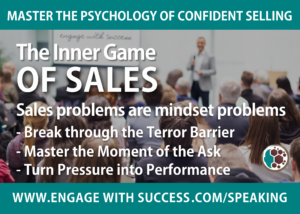
Sales Keynote
The Inner Game of Sales
Understand the psychology behind hesitation and turn resistance into confidence.
Most sales teams are trained in technique – scripts, pipelines and closing strategies. Yet deals are often lost at the exact moment the sale should happen. The real barrier is rarely skill. It’s the internal resistance that appears when asking for the decision feels exposing. Fear of judgement and rejection quietly interferes with performance.
Paul Becque has generated millions in sales through live events, television appearances and stage presentations. In this keynote he reveals the psychology behind sales hesitation and shows teams that nothing is “wrong” with them – these reactions are natural protection systems. When understood and managed, confidence rises, conversations improve and good salespeople become exceptional performers.
Recent Comments