
Is Everything Still Waiting On You?
So often we tell ourselves it’s just quicker to do the work ourselves. We know the standard, we know the context, and we can get it done without having to explain every detail. But then the workload grows, the pressure builds, and we quietly start to resent how much depends on us. There’s a painful contradiction we often miss: we long for more support, yet we keep operating in ways that make real support almost impossible. Sometimes the issue isn’t only that others can’t do the work. It’s that a part of us isn’t quite ready to stop being the one who does everything.
Reality
Delegation isn’t just about productivity – it can feel deeply personal. When your identity is built on being capable and dependable, handing work to a team member, EA, VA, or AI “agent” can seem risky. Without clear systems and checkpoints, it’s easy to worry they won’t understand the task or protect your standards. This is why so many tradesmen stay “on the tools,” even with a team around them. Every key job, decision, or problem still circles back to them. Staying at the centre can feel rewarding – being needed feels good, and fixing everything proves your value. But that’s how you end up doing work that no longer needs your unique strengths. It looks like responsibility, but it’s often control disguised as being “hands-on.”
Engagement
Delegation is not the removal of responsibility. It is the transfer of execution with enough clarity for someone else to succeed. Three small shifts can help.
- Separate Importance from Involvement.
Before accepting another task, ask: “Does this genuinely require me, or does it require clear instructions from me?” Some responsibilities need your judgement. Many simply need your expectations made visible.
- Define What Success Looks like.
Do not delegate a vague activity. Clarify the outcome, the deadline, the non-negotiables and what “good enough” means. This applies equally to a member of staff, a virtual assistant or an AI system. Trust grows more easily when clarity replaces assumption.
- Agree one review point, then step back.
Constant checking communicates that ownership has not really been transferred. Disappearing completely is not trust either. Agree when the work will be reviewed, remain available for genuine questions and allow the other person – or “agent” – to complete the process without having your hands on every movement.
The aim is not to prove that nobody can do it as well as you. The aim is to create enough capability around you that your attention can move towards the work only you can do.
Consequences
If this pattern continues, your workload will keep expanding while the people and systems around you remain underdeveloped. Your team learns to wait for you. Your assistant never gains real ownership. AI remains an occasional novelty rather than a useful capability. You become the bottleneck in the very work you are trying to grow. Eventually, being indispensable stops feeling like importance and starts feeling like imprisonment. The business, team or project cannot move faster than your personal capacity because you have trained everything to depend upon it.
Self-Recognition
- Where am I still confusing being needed with being valuable?
- What task am I holding because I have not explained it clearly?
- When do I step back in and reclaim work too quickly?
- What could grow if I stopped making myself essential to everything?
Conclusion
Self-mastery asks us to notice when responsibility has become control. You do not become less valuable when others can carry the work. You become more effective when your leadership creates capability beyond you.
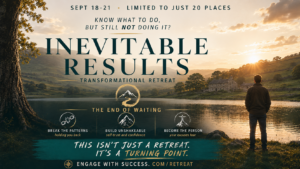
Engage with Success Retreat
Inevitable Results Transformational Retreat
Your future is shaped by what repeatedly holds your attention
But your present day is often shaped by what you are still unwilling to release. If everything still depends on you – every decision, every task, every solution – it may not simply be a workload problem. It may be a deeper pattern of identity, control or self-trust.
If you have been following these Mastery Memos, you already understand a great deal. The question is no longer whether you know the work. It is whether you are becoming the person capable of living it. That is where the Inevitable Results Retreat begins.
Over three immersive days in the beautiful surroundings of Rutland Water, you’ll discover the hidden patterns of thinking, feeling and behaviour that have quietly been shaping your results for years. More importantly, you’ll learn how to consciously redirect your attention, regulate your inner state and practise a new way of being until it becomes natural. Because when your attention changes, your decisions change.
When your decisions change, your direction changes. And when your direction changes, you can finally cross the Canyon of Change with confidence, clarity and trust. This includes recognising what genuinely requires your involvement – and what may need clearer systems, stronger boundaries, deeper trust or the courage to let go.
Unlike large events where it’s easy to disappear into the crowd, this retreat is limited to just 20 participants. That means personal coaching, meaningful conversations, genuine accountability and the space to do the inner work that lasting transformation requires.
This isn’t about positive thinking. It is not about collecting more information. It’s about mastering yourself so your outer results naturally begin to reflect the person you’re becoming.
18-21 September 2026 • Investment £2,026 • Rutland Hall Hotel & Spa
Your investment includes accommodation, all meals, refreshments, coaching sessions and retreat materials. When you are ready to stop carrying everything alone and begin creating from a more conscious, grounded and capable version of yourself, join the Priority Access List to receive your invitation when bookings open. Master Yourself. Master Change. Master Life.
Mindset starts the shift. Self-mastery makes it habitual.
Recent Comments